Will the Iran War Raise Tech Prices? What We Know (Nov 2026)
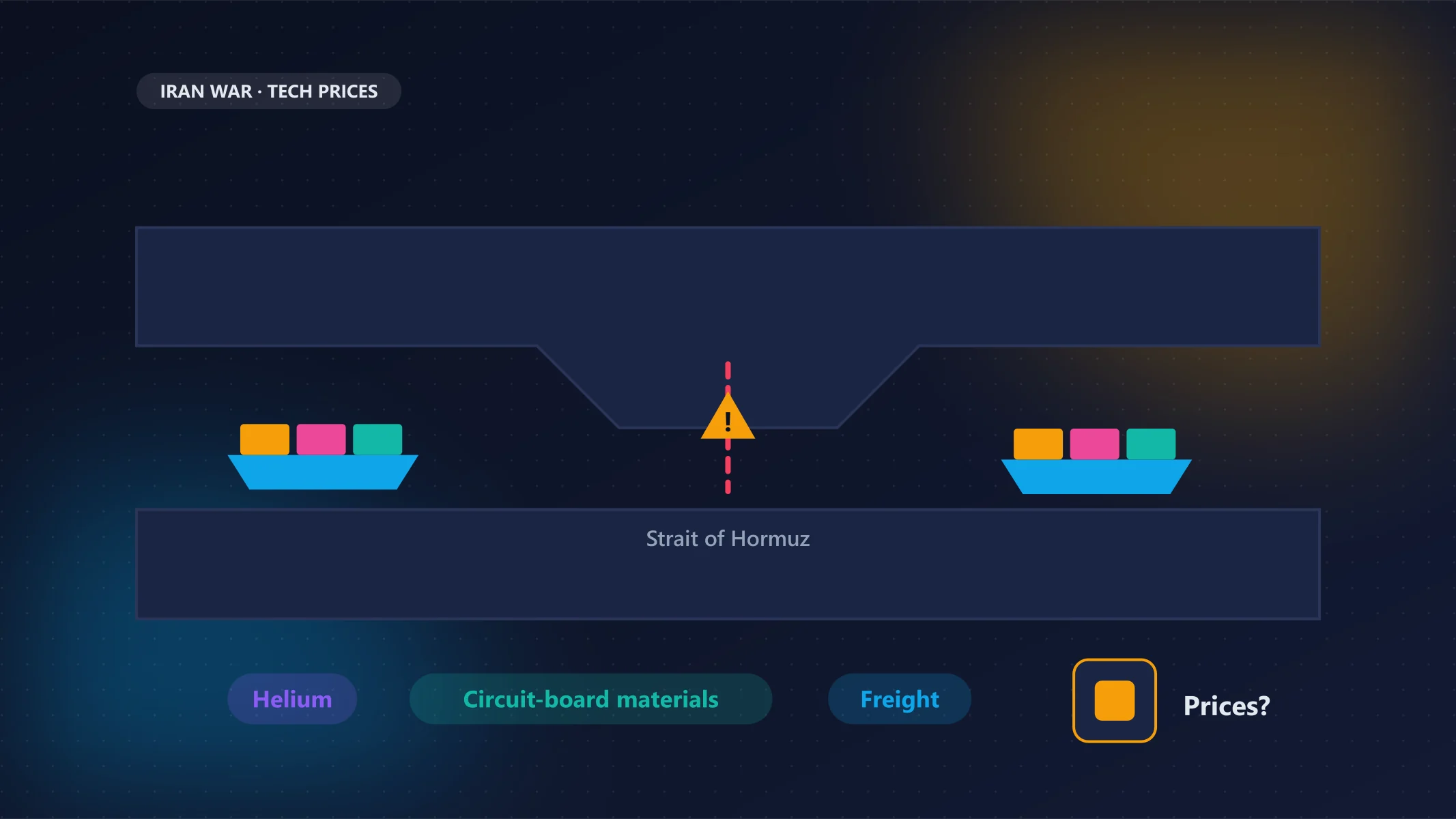
How the 2026 US-Israel-Iran war and the Strait of Hormuz disruption affect chips, helium, circuit boards and shipping, what has really got more expensive, and what it means in Sri Lanka.

On this page
If you have noticed that phones, laptops and consoles keep getting more expensive, it is natural to ask whether the war involving Iran is the reason. The honest answer is: partly, but not mostly, and nobody I could find has published a number that splits the two.
This article sets out what is confirmed, what is only an estimate, and what it means for people buying tech in Sri Lanka. It was written on 7 November 2026 from published reports. I am not taking a side in the war, and where a claim comes from one government or one anonymous source I say so.
The short version
Memory is the main reason device prices jumped in 2026: AI data centres are absorbing the world's memory supply, and the price surge was forecast two days before the war began. The war adds pressure through helium for chip plants, circuit-board materials, freight and energy. Hormuz is still severely restricted as of 4 to 6 November. I found no published figure for how much of any device's price is due to the war.
Where things stand (early November 2026)
The facts below come from Wikipedia's timeline, Al Jazeera, CBS and AP coverage, and the trade publication IndustryWeek. Claims by governments are reported as claims.
- 28 February: the US and Israel strike Iran, and Iran closes the Strait of Hormuz to foreign shipping.
- 8 April: a ceasefire is declared. 13 April: the US begins a naval blockade of Iranian ports after talks in Islamabad fail.
- 17 June: the US and Iran sign an interim memorandum with a 60-day plan to reopen the strait. 8 July: the truce collapses after attacks on ships. 14 July: the US reinstates the blockade.
- 26 September to 4 October: President Trump rejects Iran's seven-day reopening plan, and an Iranian official says the strait will stay closed until Iran's seven conditions are met.
- 4 November (IndustryWeek): the strait is "severely constrained", operating at a fraction of normal traffic. S&P Global counted about 750 observed and assumed transits in October, a three-month high. The maritime monitor UKMTO logged seven attack reports between 29 October and 3 November.
- 6 November (Outlook India, citing AP): the US maintains its blockade and attacks on shipping continue. Unnamed regional officials say mediators are discussing a deal in which Iran stops attacking ships in the strait and the US lifts the blockade. No agreement has been confirmed.
Oil: the most recent dated figure I found is from 27 August, when Brent crude was $87.36 a barrel, against about $72 in late February (AP, via CBS). I could not find a reliable October or November price, so I do not quote one.
How a war in the Gulf reaches your devices
1. Helium for chip factories
Helium is used in making semiconductors, and Qatar is a major source. AP reported on 21 March that Qatar supplies about a third of the world's helium (the US Geological Survey figure it cites, which it also gives as "about 30 percent"). QatarGas halted production on 2 March and declared force majeure two days later. After strikes on the Ras Laffan site, QatarGas reported "extensive" damage that will take years to repair and said annual helium exports were cut by 14 percent.
South Korea is the most exposed: Fitch Ratings, cited by AP, says it gets about 65 percent of its helium from Qatar. Analysts quoted in March said Samsung and SK Hynix probably held several months of inventory, the Korea Semiconductor Industry Association said short-term supply was sufficient, and TSMC said it did not expect a significant impact "at this time". A June insurance-industry newsletter (IUMI) says Korean and Taiwanese chipmakers were by then working under rationed supply, but it does not name a source for that, so treat it as unconfirmed. AP and IUMI both say helium spot prices roughly doubled.
I could not find a source that covers Japanese chipmakers' exposure.
2. Circuit-board materials
Reuters reporting, repeated by Gizmodo and Analytics Insight on 27 April, says circuit-board (PCB) makers faced higher costs: copper foil up about 30 percent, and a shortage of a resin (polyphenylene ether, PPE) made in Jubail, Saudi Arabia, after an attack there on 7 April that Iran's Fars news agency claimed. Both articles say PCB manufacturing costs rose about 40 percent in April. Both appear to trace back to a single Reuters report quoting an unnamed executive, so this is one source repeated, not two. Analytics Insight adds that SABIC supplies around 70 percent of the world's high-purity PPE, again on an unnamed source.
3. Shipping and insurance
- Carriers added war surcharges from 2 March, for example CMA CGM's Emergency Conflict Surcharge of $2,000 to $4,000 per container and Hapag-Lloyd's war-risk surcharge of $1,500 per TEU for dry cargo (Daily FT column, 5 March).
- A Sri Lankan shipping expert said in late March that bunker fuel was up "nearly 150 percent" and that diverting around the Cape of Good Hope can add up to 21 days (Daily FT, 26 March). An earlier column gave 10 to 14 days, so the delay depends on the route.
- About 170 container ships (roughly 450,000 TEU) were en route when the strait closed (TSTRONIC, 2 March, an estimate).
4. Energy and inflation
Higher oil and gas prices raise the cost of making and moving everything, including electronics. I found no source that quantifies this for devices.
What has actually got more expensive?
Here is the key point. The big, confirmed price rises of 2026 are explained by companies and analysts mainly as memory cost, not the war:
- Analysts at TrendForce forecast on 26 February, two days before the war began, that conventional DRAM contract prices would rise by 90 to 95 percent in the first quarter.
- Microsoft raised Xbox prices from 1 August and said console storage and memory prices have risen by more than 2.5 times. Nintendo (Switch 2, from 1 September) cited "changes in market conditions" and Sony (PS5, from April) cited global economic pressures, and outlets link both to component and memory costs.
- Apple's CEO said on the July earnings call that Apple "reluctantly raised prices" on some products because of memory costs, according to Business Today and ARY News.
We explain the memory side in detail in why RAM prices exploded in 2026.
So the best summary is: the war is an extra cost on top of an AI-driven memory shortage, not the main cause of it. None of the reports I read apportions the cause between the two. One outlet (Gizmodo) argues the war is making matters worse across tech, but its piece is strongly opinionated, so I have not used it for any number.
What it means in Sri Lanka
Sri Lanka is exposed through fuel and freight rather than through chips:
| Fuel (Ceypetco, per litre) | Nov 2025 | 30 May 2026 | Change |
|---|---|---|---|
| Petrol 92 | Rs 294 | Rs 434 | +47.6% |
| Auto diesel | Rs 277 | Rs 407 | +46.9% |
| Super diesel | Rs 318 | Rs 478 | +50.3% |
Source: a table in a Centre for Poverty Analysis (CEPA) blog post dated 30 June 2026. These are the latest pump prices I could find, so check Ceypetco for today's prices.
- The Container Transport Owners' Association raised its charges by 20 percent in late March (Daily Mirror, 23 March), citing higher fuel costs.
- A Colombo-based analysis (IPS, 20 March) modelled a possible 38.9 percent fuel price shock. That is a projection, not a price that was charged.
- Electronics: none of the Sri Lankan reports I read mention computers, phones or other electronics, and I did not find a published figure for how much electronics prices have moved because of the war. If a shop tells you a price rise is "because of the war", ask what changed in its supplier invoice.
If you are buying a phone in Sri Lanka, see our guide to second-hand iPhones in Sri Lanka for what used models actually cost.
What to do if you are about to buy tech
These are my suggestions, not official advice:
- Do not panic-buy on the strength of "the war" alone. The price rises with a clear explanation are the memory-driven ones.
- Check the RAM and storage in the exact model, because that is where most of the increase sits.
- Compare two or three sellers and ask for the price in writing, since local prices can differ by importer.
- Consider used or refurbished if a new model is out of budget, and run the checks in our used-iPhone guide.
What would change the picture
Watch three things: whether the Strait of Hormuz reopens, whether Qatar's helium output recovers, and what happens to freight and oil prices. I cannot predict any of them, and reports disagree on how long normal supply would take to return after a reopening.
FAQ
Is the Iran war making laptops and phones more expensive?
Probably a little, through freight, energy and some materials, but the large price rises of 2026 are mainly attributed to memory costs. I found no source that measures the war's share.
Why is helium important for chips?
Chip factories use helium in manufacturing, and Qatar supplies about a third of the world's helium, almost all of it shipped through the Strait of Hormuz, so the closure and the strikes on Ras Laffan hit supply.
Is the Strait of Hormuz open now?
As of 4 to 6 November 2026 it is severely restricted. Iran says it stays closed until its conditions are met, the US says it maintains a blockade of Iranian ports, and mediators are working on a deal that has not been confirmed. Check the latest news.
Has the war affected prices in Sri Lanka?
Fuel prices rose sharply (petrol 92 from Rs 294 to Rs 434 between November 2025 and May 2026) and container charges rose 20 percent in March. I did not find a published figure for electronics.
Will phone and laptop prices come down if the war ends?
Not necessarily. The memory shortage is a separate cause, and Micron's CEO says he sees demand exceeding supply through 2027 and 2028.
What I could not verify
- I could not read Tom's Hardware's reporting on chip supply or Gartner's own page, and several outlets blocked automated access.
- The PCB cost rise and the helium price doubling each come from a single original source.
- I found no oil price after 27 August, and no Sri Lankan electronics price data.
- Wikipedia's timeline was read only in part, and some dates in it come from a summary.
Sources
- 2026 Strait of Hormuz campaign (Wikipedia, timeline)
- Iran says Hormuz to remain closed until US meets conditions (Al Jazeera, 4 October 2026)
- Strait of Hormuz Watch (IndustryWeek, updated 4 November 2026)
- Will Hormuz Reopen? (Outlook India, 6 November 2026)
- Iran war live updates (CBS News and AP, oil price on 27 August)
- Iran war halts Qatar helium output (AP via WTOP, 21 March 2026)
- Qatari helium shortages (IUMI newsletter, June 2026)
- Trump's war on Iran is really messing up the tech that runs modern life (Gizmodo, 27 April 2026, opinionated, used only for the Reuters-sourced figures)
- US-Iran war triggers PCB shortage (Analytics Insight, 27 April 2026)
- The impact of the USA-Israel-Iran conflict on the electronics industry (TSTRONIC, 2 March 2026)
- Sri Lanka: Daily FT, 26 March, Daily FT column, 5 March, Daily Mirror, 23 March, Lanka Business Online, 20 March and CEPA, 30 June
- Memory costs and the 2026 price surge (our RAM explainer)
Related reading
How this was researched
This article is based on official documentation, pricing pages and the other sources listed in the article. It does not include my own hands-on testing. I update articles when pricing or features change. Read my review process.

About the author
Sameera Jayakodi
Software engineer and founder of TechToolHub
I'm Sameera Jayakodi, a software engineer based in Sri Lanka. I use AI, developer and productivity tools in my own work every day, and I started TechToolHub to give clear, honest comparisons without the hype. Every article is researched from official sources, and the ones marked "Hands-on tested" include my own testing.
Related articles
World War 3 and Technology: What the Iran War Shows So Far
The 2026 Iran war has shown real weak points (GPS jamming, an internet shutdown, drone hits on cloud data centres), but undersea cables had been spared as of late April and the Strait of Hormuz carries under 1% of global bandwidth.
Why RAM Prices Exploded in 2026 and When They May Fall
AI demand, not the Iran war, is the main reason RAM and device prices jumped in 2026, and Micron says it does not see supply and demand balancing in 2027 or 2028.
Best Second-Hand iPhones in Sri Lanka (2026 Buying Guide)
For most buyers in Sri Lanka the iPhone 12 (128GB, about Rs 78,000 asking) is the best-value used iPhone; the iPhone 11 is the cheapest model Apple still lists for iOS 27.