World War 3 and Technology: What the Iran War Shows So Far
No one can say whether a bigger war is coming. This guide sticks to what the 2026 Iran war has already done to GPS, the internet, data centres and undersea cables, based on published reports.

On this page
People are searching for "World War 3" because of the war involving Iran, the United States and Israel, and many want to know one practical thing: what happens to my phone, my internet and my work if it gets worse?
Nobody can answer whether a bigger war is coming, and I will not guess. What I can do is show what has already happened to technology in this war, according to published reports, and separate confirmed events from claims and threats. This was written on 7 November 2026.
I am deliberately not using the label "World War 3" for this war. Whether a conflict deserves that name is a judgement for historians. The sources I cite describe a war centred on the Gulf region with large economic effects around the world.
What the reports show so far
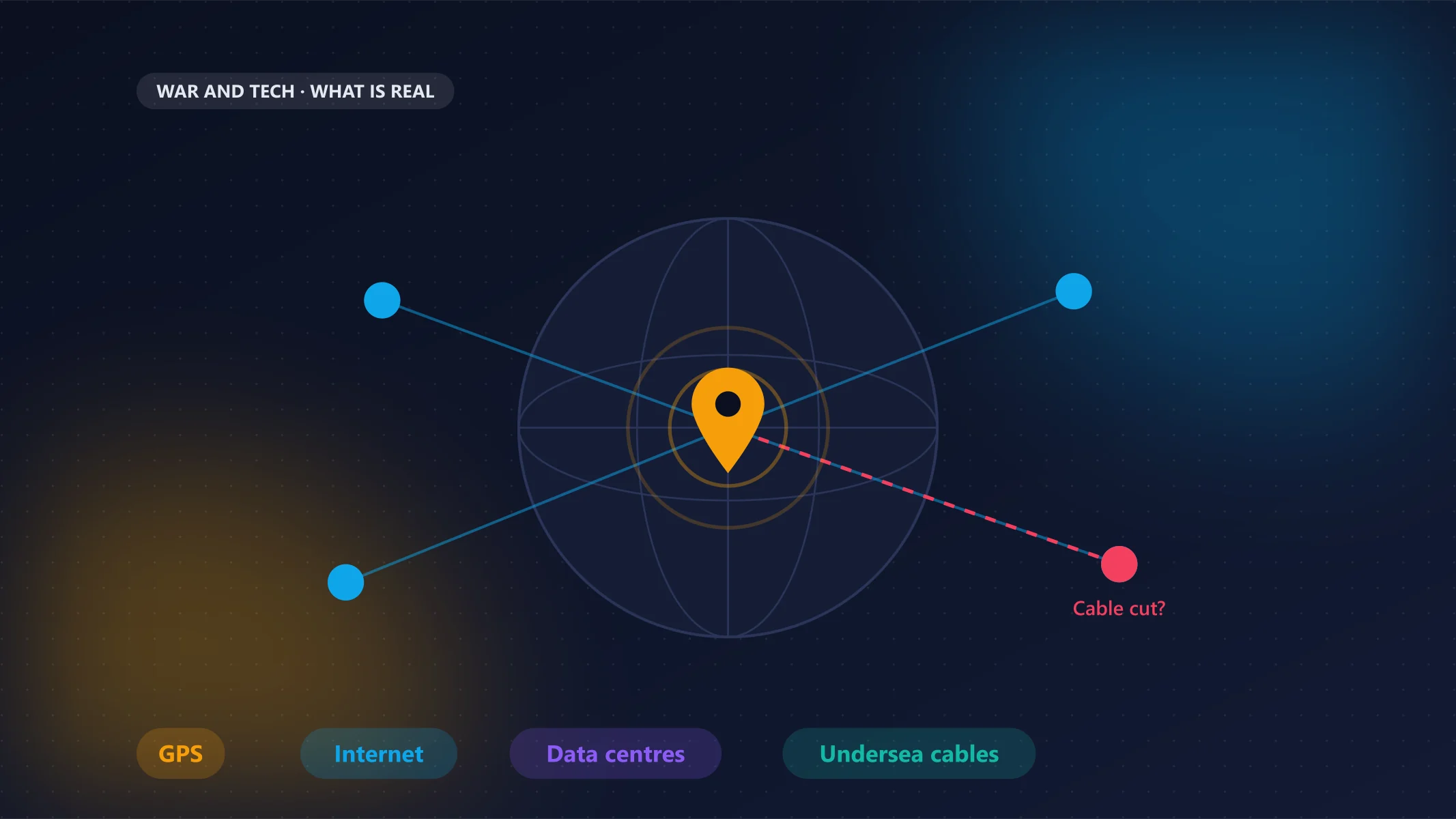
GPS jamming has hit large numbers of ships, and reports say it disrupted some delivery and map apps. Iran's own internet fell to about 4% of normal on 28 February. Amazon Web Services data-centre facilities in the Gulf were reportedly hit by drones. Undersea cables had been spared as of late April, though Iranian officials have threatened them. Less than 1% of global international bandwidth passes through the Strait of Hormuz.
GPS jamming and spoofing
GPS signals are weak and easy to drown out. In this war, jamming and "spoofing" (false location signals) have been widely reported at sea.
- Gadget Review (10 March), linking to a CNN report, says more than 1,100 commercial ships lost GPS positioning within 24 hours of the strikes that began on 28 February. I did not read the original report, so treat the number as second-hand.
- In a post on 1 November, Windward said GPS jamming affected 124,235 vessels worldwide in the third quarter of 2026. That is a vendor's own count and I could not verify it independently.
- Khaleej Times (12 March) reported GPS jamming and spoofing that affected parcel and food-delivery platforms in the region and caused erratic digital maps. The reports were hedged and did not name the platforms.
- Even the data used to count ships is affected: the IMF's PortWatch tracker says its transit numbers may be incomplete because of GPS jamming, spoofing and ships turning off their transponders (via IndustryWeek, 4 November).
The Iranian internet shutdown
On 28 February, Iran's national internet connectivity fell to about 4 percent of normal, according to the monitoring group NetBlocks (via Fox News on 1 March). Cloudflare said traffic fell to almost zero at 18:45 UTC (via ThaiCERT, 2 March). NetBlocks said the pattern resembled earlier government-imposed restrictions, which suggests an intentional shutdown, but the cause was not confirmed in the reports I read.
I have not included claims from a low-quality site about a longer January shutdown and large casualty figures, because I could not verify them.
Cyberattacks: reports, not proof
Fox News (1 March) and ThaiCERT (2 March) report cyberattacks alongside the military strikes, including disruption of Iranian state news agencies and government services. Some of this is described with "reportedly" and anonymous sources, and none of the reliable pages I read names an attacker. An analyst quoted by Khaleej Times said some banks saw settlement delays, based on reports. Treat this section as unconfirmed.
Data centres and the cloud
This is one of the most concrete cases. Khaleej Times (12 March) reports that drone strikes in early March damaged three Amazon Web Services facilities in the Middle East and that AWS reportedly confirmed structural damage and power disruption. Dawn, republishing Reuters (28 April), refers to hits on AWS data centres in Bahrain and the UAE. The sources I read do not name who carried out the strikes.
The lesson for any business is simple: a cloud "region" is a set of buildings in a place, and places can be attacked.
Undersea cables
Undersea cables carry about 99 percent of international internet traffic, according to the International Telecommunication Union (as quoted by Dawn). So the fear that a war could cut them is real. Here is what is known:
- What has happened: Dawn, republishing Reuters on 28 April, said subsea cables had been spared so far. I did not find a later report of damage to cables in the Strait of Hormuz.
- What has been threatened: Reuters, as relayed by Ynet, quoted two senior Iranian security officials saying Iran has plans to target Gulf undersea cables and block repairs if the war resumes, and an IRGC official publicly said seven major cables beneath the strait could be targeted. These are threats, not actions, and Ynet's article is undated.
- How much would a cut matter globally: TeleGeography, quoted by Ynet, says less than 1 percent of global international bandwidth passes through the Strait of Hormuz, so the impact would be mainly regional, though serious for Gulf countries.
- How long repairs take: the cable industry body ICPC counts about 150 to 200 cable faults a year, and 70 to 80 percent are accidental (fishing and anchors). Repairing three Red Sea cables in 2024 took about six months, according to TeleGeography.
Chips and prices
War also reaches technology through supply chains: helium for chip plants, circuit-board materials and shipping costs. We cover this in Will the Iran War Raise Tech Prices?. The sharp rise in RAM and device prices is mainly a separate story about AI demand, explained in why RAM prices exploded in 2026.
What ordinary people can do
I did a limited check for official public guidance on these specific risks, including the most recent page of the US cyber agency CISA's advisory list, and did not find any for this war. The points below are therefore my own suggestions, based on the weak points above, not official advice:
- Save offline maps of your area, because GPS and mapping apps can fail, and mobile networks can be congested in a crisis.
- Back up what matters (photos, documents, passwords) to somewhere other than one phone or one cloud account.
- Keep a charged power bank and know how to reach your family if the internet is down.
- Keep two-factor recovery codes somewhere safe and offline.
- If you run a business, do not depend on a single cloud region, and test your backups.
- Be careful with viral war posts. Wait for confirmation from several established news outlets before sharing.
FAQ
Will the internet go down if World War 3 starts?
Nobody can promise either way. In this war, Iran's own connectivity fell to about 4 percent on 28 February, and cable damage in the Strait of Hormuz had not been reported as of late April. Less than 1 percent of global international bandwidth passes through the strait, so a cut there would be mainly regional.
Is GPS affected for ordinary people?
Reports describe GPS jamming affecting ships and some delivery and map apps in the Gulf region. I found no reliable evidence about effects elsewhere.
Has any data centre been attacked?
Khaleej Times and Reuters (via Dawn) reported drone hits on Amazon Web Services facilities in the Gulf, including Bahrain and the UAE.
Are undersea cables safe?
As of late April they had been spared, but Iranian officials have threatened to target Gulf cables. Cable faults are common, and repairs can take months.
Is this war a world war?
I do not use that label. The sources I cite describe a war centred on the Gulf region, with global economic effects such as shipping disruption and higher costs.
What I could not verify
- FDD's analysis, Cloudflare's outage data and the NetBlocks report were blocked or not reachable when I checked, so some figures come second-hand.
- The Windward figures are the company's own counts.
- The Ynet article on cable threats is undated, and I could not read the original Reuters report.
- I found no confirmed attribution for the cyberattacks, and no official public guidance.
Sources
- US-Israel-Iran war turns cloud infrastructure into battlefield (Khaleej Times, 12 March 2026)
- The Hormuz digital chokepoint: how does the war on Iran threaten subsea cables? (Dawn, republishing Reuters, 28 April 2026)
- Iran plans to cut Gulf internet cables and block repairs if war resumes (Ynet, undated, citing Reuters)
- Iran networks suffer losses amid airstrikes (Fox News, 1 March 2026)
- Internet in Iran nearly goes dark (ThaiCERT, 2 March 2026)
- GPS attacks near Iran are breaking delivery and mapping apps (Gadget Review, 10 March 2026)
- Windward (maritime analytics firm, posts of 29 October and 1 November 2026)
- Strait of Hormuz Watch (IndustryWeek, 4 November 2026)
- CISA advisories (checked for public guidance)
Related reading
How this was researched
This article is based on official documentation, pricing pages and the other sources listed in the article. It does not include my own hands-on testing. I update articles when pricing or features change. Read my review process.

About the author
Sameera Jayakodi
Software engineer and founder of TechToolHub
I'm Sameera Jayakodi, a software engineer based in Sri Lanka. I use AI, developer and productivity tools in my own work every day, and I started TechToolHub to give clear, honest comparisons without the hype. Every article is researched from official sources, and the ones marked "Hands-on tested" include my own testing.
Related articles

Will the Iran War Raise Tech Prices? What We Know (Nov 2026)
The war adds real costs (helium, circuit-board materials, freight, energy), but the sharp device price rises of 2026 are mainly about memory, and I found no source that puts a number on the war share.

Why RAM Prices Exploded in 2026 and When They May Fall
AI demand, not the Iran war, is the main reason RAM and device prices jumped in 2026, and Micron says it does not see supply and demand balancing in 2027 or 2028.
Best Second-Hand iPhones in Sri Lanka (2026 Buying Guide)
For most buyers in Sri Lanka the iPhone 12 (128GB, about Rs 78,000 asking) is the best-value used iPhone; the iPhone 11 is the cheapest model Apple still lists for iOS 27.