Freelance Payments in Sri Lanka (2026): PayPal vs Payoneer vs Wise
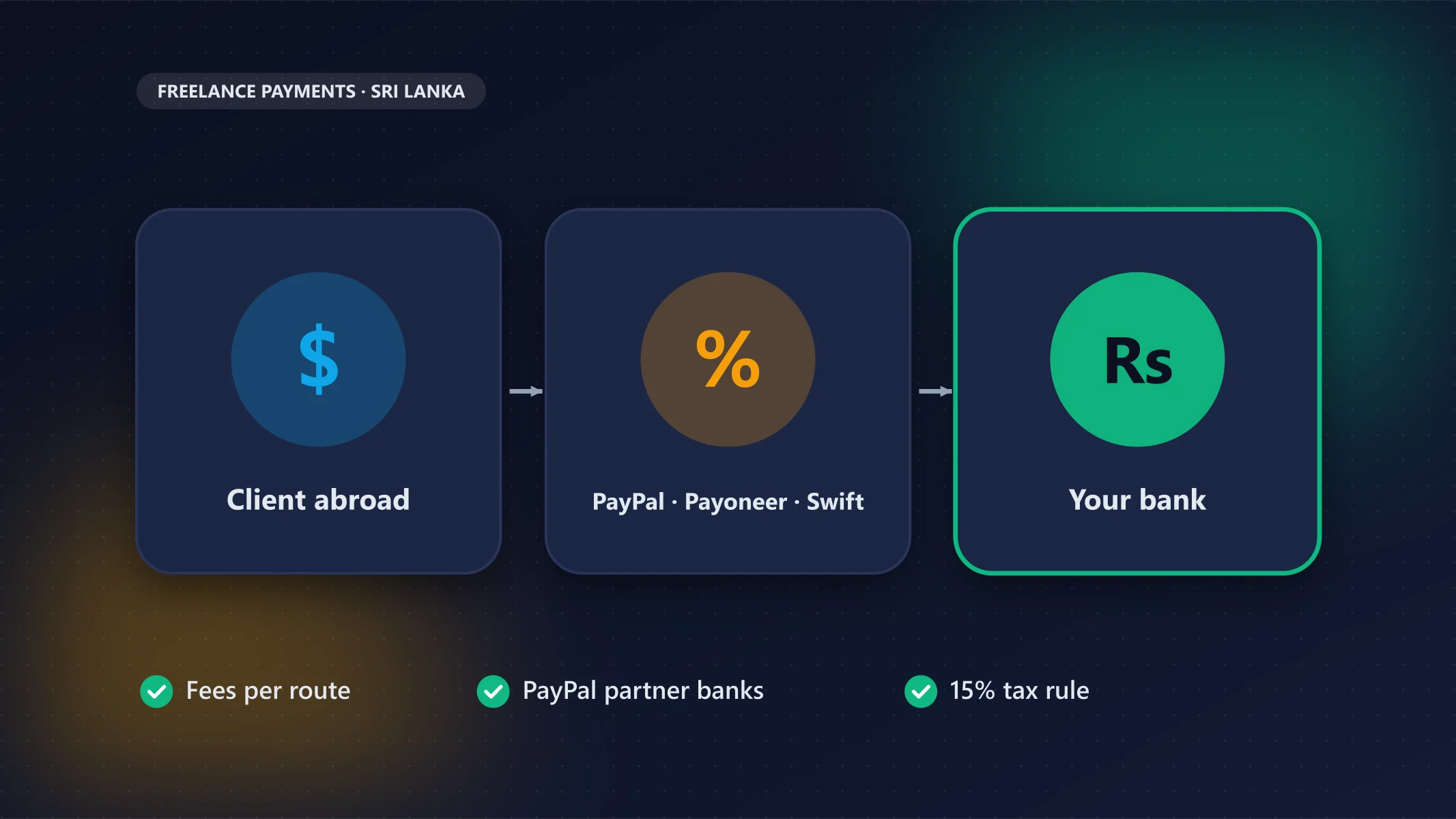
PayPal now works in Sri Lanka through Sampath and Commercial Bank, Wise still cannot give you USD account details, and Upwork pays straight to a local bank for $0.99. Fees for every route, from the official pages on 9 November 2026.

On this page
- The options at a glance
- If you work on Upwork or Fiverr
- PayPal: finally works, but it is the expensive option
- Payoneer: the usual choice for direct clients
- Wise: not a way to get paid from Sri Lanka
- Direct bank transfer: often the cheapest for larger invoices
- Which one should you use?
- Tax: the 15% rule
- Stay safe
- FAQ
- What I could not check
- Sources
- Related reading
Getting paid from abroad used to be the hardest part of freelancing from Sri Lanka. That changed in May 2026, when PayPal finally let Sri Lankan accounts receive money. But PayPal is not the cheapest route, Wise still does not work the way most guides say, and the best option depends on whether you work through Upwork, Fiverr or your own clients.
This guide compares the five routes Sri Lankan freelancers actually use: platform payouts, PayPal, Payoneer, Wise and a direct bank transfer. Every fee below comes from the provider's own page, read on 9 November 2026. I have not run a payment through every route myself, so anything I could not confirm is marked as such.
The short version
Upwork: withdraw with Direct to Local Bank, $0.99 per withdrawal (up to $13,000 for Sri Lanka). Fiverr: Bank Transfer (via Payoneer) costs $1; PayPal costs nothing on Fiverr's side but PayPal charges 2.9% + $2.50 to move it to your bank. Direct clients: ask for a bank transfer to your Sri Lankan account, or use a Payoneer receiving account (1% to receive, 1.2–4% to withdraw). PayPal is the most expensive: about 7.7% of a $500 payment before your bank's charges. Wise: you cannot get USD account details with a Sri Lankan address. Tax: since 1 April 2025, foreign-currency service income brought in through a Sri Lankan bank is taxed at up to 15%.
The options at a glance
| Route | How the money reaches you | Main fees (official pages, 9 Nov 2026) | Best for |
|---|---|---|---|
| Upwork Direct to Local Bank | Upwork pays your Sri Lankan bank account | $0.99 per withdrawal, plus incoming fees at some banks | Upwork freelancers |
| Fiverr payouts | PayPal, Payoneer, or a bank transfer via Payoneer | $0 (PayPal), $1 (bank transfer via Payoneer), $3 (Payoneer account) | Fiverr sellers |
| PayPal | PayPal balance, then your linked partner bank | 4.40% + $0.30 to receive, 2.9% + $2.50 to withdraw | Clients who will only pay by PayPal |
| Payoneer | USD receiving account, then your bank or eZ Cash | 1% to receive (min $1), 1.2–4% to withdraw to a local bank | Direct clients, several platforms |
| Direct bank transfer (Swift) | Client's bank sends to your Sri Lankan bank | Set by the banks involved; often low on the receiving side | Larger invoices from regular clients |
| Wise | Not available to receive USD with a Sri Lankan address | — | Your client can use Wise to send to you |
If you work on Upwork or Fiverr
Platforms pay you themselves, so the choice is only how you withdraw.
Upwork
Upwork's help centre lists Direct to Local Bank for Sri Lanka at $0.99 per withdrawal, with a limit of $13,000 per withdrawal. Some banks add an incoming fee, and Upwork says sending in your local currency "may reduce or eliminate" it. Withdrawals should arrive within four business days.
The other options are PayPal, Payoneer and a US dollar wire, which costs $50 per transfer. Unless you need the money in a PayPal or Payoneer balance, Direct to Local Bank is the cheapest of the four. These are withdrawal fees only; Upwork's own service fee on your earnings is separate.
Fiverr
Fiverr's withdrawal table, as published on 9 November 2026:
| Payout method | Transfer time | Fiverr's fee | Minimum |
|---|---|---|---|
| PayPal | 24 hours | $0 | $1 |
| Bank Transfer (via Payoneer) | 1–3 business days (local currency) or 5–7 (USD wire) | $1 | $20 |
| Payoneer account | Up to 2 business days | $3 | $10 |
| Fiverr Revenue Card | Up to 2 business days | $1–$3 | $30 |
You can withdraw up to $5,000 per transaction. Fiverr discontinued the Revenue Card in December 2022, so it is only for people who already have one.
PayPal looks free here, but that is only Fiverr's side. Moving the money from PayPal to a Sri Lankan bank costs 2.9% + $2.50 (see below). Bank Transfer (via Payoneer) has the lowest fixed fee, but Fiverr does not say what exchange rate is used when it pays in rupees. Compare the rupee amount you actually receive before you settle on one.
PayPal: finally works, but it is the expensive option
On 15 May 2026, PayPal started letting Sri Lankan accounts receive money from abroad, with Sampath Bank, Commercial Bank and Bank of Ceylon announced as partners. Six months later, PayPal's own partner page shows a more limited picture:
| Bank | Sign-up and linking | Withdrawals | Receiving payments for goods and services |
|---|---|---|---|
| Sampath Bank | Live (personal accounts) | Live (personal) | Live (personal) |
| Commercial Bank | Live (personal accounts) | Live (personal) | Live (personal) |
| Bank of Ceylon | Coming soon | Coming soon | Coming soon |
Business accounts, PayPal invoicing and PayPal Checkout are all still "coming soon" for every bank. PayPal also says that linking your PayPal account to a partner bank is mandatory to receive or withdraw money in Sri Lanka. In practice, you need an account at Sampath or Commercial Bank and a personal PayPal account linked through that bank's app or online banking.
What PayPal costs
PayPal's Sri Lanka fee page (last updated 28 October 2026) lists:
- Receiving an international commercial payment: 4.40% + $0.30 for a USD payment. Sri Lanka falls under "all other markets" in PayPal's table.
- Withdrawing to your bank: 2.9% + $2.50 per withdrawal, plus whatever your bank charges. PayPal adds that "additional fees will be charged by your third-party service provider".
- Currency conversion: if PayPal converts currencies for you, it adds its own margin above the base rate (3% for "all other" conversions, 4% when sending payments from Sri Lanka).
Here is what that means for a single $500 payment from a client abroad:
| Step | Fee | Left |
|---|---|---|
| Client pays you $500 | $500.00 | |
| PayPal receiving fee (4.40% + $0.30) | −$22.30 | $477.70 |
| Withdrawal to bank (2.9% + $2.50) | −$16.35 | $461.35 |
That is $38.65, or about 7.7%, before your bank's own withdrawal charge and before the dollars become rupees. This is my own calculation from PayPal's published rates; your PayPal app shows the exact fee before you confirm each step.
PayPal is worth it when a client will only pay that way, or for small one-off jobs. For regular work, the routes below keep more of your money.
Payoneer: the usual choice for direct clients
Payoneer gives you receiving accounts: bank details in the US and other countries that clients can pay into like a normal local transfer. From its pricing page (last updated 1 January 2026):
- Receiving into a currency that is not your local currency (for example a USD account when you live in Sri Lanka): 1%, minimum $1.
- From a marketplace that pays through Payoneer: the fee "varies by marketplace".
- From a client paying by card: up to 3.99% + $0.49.
- Withdrawing to a bank account in your local currency, with conversion (USD to rupees): 1.2% to 4%. In some countries a minimum fee of up to $20 applies. Sri Lanka is not on the list of countries that get the flat $1.50 same-currency withdrawal.
- Annual account fee: $29.95, but only if your account receives less than $6,000 in any 12 consecutive months.
For the same $500 paid into a USD receiving account, the receiving fee is $5, and the withdrawal to a Sri Lankan bank costs $5.94 to $19.80, depending on where you fall in that 1.2–4% range. You keep roughly $475 to $489, about 2–5% in fees. Your Payoneer withdrawal screen shows the exact rate before you confirm.
You can also withdraw straight to an eZ Cash wallet. Payoneer's guide (updated 23 September 2026) explains how to link the two in the eZ Cash app; eZ Cash then credits you in rupees. Neither page lists a fee or limit for this route, so check in the app first.
Check that you can still sign up
Payoneer's pricing page says some regions require an annual plan and that "in certain countries, a registration fee may apply". Some Sri Lankan blogs claim new accounts from Sri Lanka are restricted. I could not confirm either way, so check what the sign-up form shows before you send clients your details.
Wise: not a way to get paid from Sri Lanka
Many guides recommend Wise, but Wise's own help centre says you can't get USD account details if your address is in Sri Lanka. Sri Lanka sits on the same list as Pakistan, Bangladesh and Nigeria. You can still open a Wise account, but it will not give you the US account number and routing number that freelancers use to get paid.
Wise is still useful from your client's side. Wise lists Sri Lanka among the countries its customers can send US dollars to by Swift, so a client with a Wise account can pay straight into your Sri Lankan bank account. Wise says those transfers can take up to six working days and cost a bit more, because they go through intermediary banks.
Direct bank transfer: often the cheapest for larger invoices
A client can send money straight to your Sri Lankan bank account with an international (Swift) transfer. You give them your name, account number, bank name and branch, and the bank's Swift code.
The receiving side is often cheap. As one example, People's Bank's foreign currency tariff (July 2026) charges nothing to credit an inward Swift remittance to one of its own foreign currency accounts and Rs. 100 to credit one of its LKR accounts. It notes that "correspondent bank charges (deducted by them)" may still apply. Other banks publish their own tariffs, so check yours.
The real costs of a Swift transfer are usually:
- The client's bank fee for sending the transfer.
- Intermediary (correspondent) bank deductions along the way, which can take a few dollars off the amount that arrives.
- The exchange rate, if the money is converted to rupees. Banks use their own buying rate.
Two habits help. Agree with the client who pays the transfer charges (Swift calls these OUR, SHA and BEN), and ask your bank whether a foreign currency account suits you better than converting every payment to rupees straight away.
Which one should you use?
- You work on Upwork: Direct to Local Bank.
- You work on Fiverr: compare Bank Transfer (via Payoneer) with PayPal by the rupees you actually receive. If you already bank with Sampath or Commercial, PayPal is convenient, but its 2.9% + $2.50 withdrawal fee adds up.
- You have regular direct clients: a direct bank transfer for larger invoices, or a Payoneer USD receiving account if clients want to pay like a local US transfer.
- A client insists on PayPal: fine for occasional work. Consider adding the fee to your quote.
- Someone tells you to use Wise to receive USD: not with a Sri Lankan address.
Tax: the 15% rule
Until March 2025, income from services provided to foreign clients was tax-exempt when it was remitted to Sri Lanka. The Inland Revenue (Amendment) Act, No. 2 of 2025 changed that from 1 April 2025. Tax advisers summarise the new rule like this:
- Service income paid in foreign currency and remitted to Sri Lanka through a bank is taxed at a maximum of 15%.
- If the income is not brought in through a Sri Lankan bank, regular progressive rates apply, which go up to 36%.
I am not a tax adviser. Keep records of every payment (invoices, platform statements, bank credits), and ask the Inland Revenue Department or a tax professional how the rule applies to your route. For example, ask whether a PayPal withdrawal through a partner bank counts as "remitted through a bank".
Stay safe
- Never give your PayPal or Payoneer login to an "agent" who offers to withdraw for you for a fee. With PayPal's partner banks live, there is no reason to.
- Your name must match everywhere. Upwork, for example, requires the account holder name on your withdrawal method to match your verified name, including middle names.
- Be wary of overpayment scams, where a "client" pays too much and asks you to send the difference back.
FAQ
Can I receive money with PayPal in Sri Lanka now?
Yes, since 15 May 2026, if you link a personal PayPal account to Sampath Bank or Commercial Bank. Bank of Ceylon support is still listed as coming soon, and business accounts are not supported yet.
Which banks work with PayPal in Sri Lanka?
PayPal's partner page lists Sampath Bank and Commercial Bank as live for personal accounts, and Bank of Ceylon as coming soon (checked 9 November 2026).
How much does PayPal charge in Sri Lanka?
4.40% + $0.30 to receive an international commercial payment in USD, and 2.9% + $2.50 to withdraw to your bank, plus your bank's own charges. On a $500 payment that comes to about $38.65.
Can Sri Lankans use Wise to receive USD?
No. Wise's help centre lists Sri Lanka among the countries where you can't get USD account details. Your client can still use Wise to send US dollars to your Sri Lankan bank account by Swift.
What is the cheapest way to withdraw Upwork earnings in Sri Lanka?
Direct to Local Bank, at $0.99 per withdrawal, with a $13,000 limit for Sri Lanka. Your bank may add an incoming fee.
Do freelancers in Sri Lanka pay tax on foreign income?
Since 1 April 2025, yes. Foreign-currency service income brought in through a Sri Lankan bank is taxed at up to 15%; income kept outside the banking system faces regular rates of up to 36%. Check your situation with the IRD or a tax adviser.
What I could not check
- I have not sent a test payment through each route, so the worked examples are calculations from published rates, not real receipts.
- PayPal's consumer fee page did not load for my checks, so the PayPal figures come from its Sri Lanka business fee page. Personal accounts may see different numbers in the app.
- Sampath and Commercial Bank's own charges for PayPal withdrawals were not on PayPal's page, which says to ask the bank.
- I could not confirm whether Payoneer still accepts new accounts from Sri Lanka without an annual plan or registration fee, or what eZ Cash withdrawals cost.
- Fiverr does not publish the exchange rate it uses for Bank Transfer (via Payoneer) in rupees.
- Exchange rates and banks' buying rates change daily and are not included in any of the totals.
Sources
- PayPal Partner Banks in Sri Lanka (PayPal, read 9 November 2026)
- Seller Fees for Merchants and Businesses, Sri Lanka (PayPal, last updated 28 October 2026)
- Sri Lanka marks new phase in digital payments with PayPal launch (Newswire, 15 May 2026) and Direct PayPal money receiving service to launch in Sri Lanka from May 15 (Ada Derana Biz)
- Payoneer pricing (Payoneer, last updated 1 January 2026)
- How to integrate eZ Cash with Payoneer (Payoneer, updated 23 September 2026)
- Can I get USD account details? and What countries and regions can I send USD to via Swift? (Wise Help Centre)
- How to get paid on Upwork and Fees, limits and timing of Direct to Local Bank payments (Upwork Help)
- Withdrawing your earnings and managing payout methods (Fiverr Help Center)
- Foreign Currency Tariff (People's Bank, July 2026)
- How taxes will affect service exporters in Sri Lanka (TaxAdvisor.lk) and Service exports hit by 15% tax on freelancers, IT sector (The Sunday Times, 2 March 2025)
Related reading
How this was researched
This article is based on official documentation, pricing pages and the other sources listed in the article. It does not include my own hands-on testing. I update articles when pricing or features change. Read my review process.

About the author
Sameera Jayakodi
Software engineer and founder of TechToolHub
I'm Sameera Jayakodi, a software engineer based in Sri Lanka. I use AI, developer and productivity tools in my own work every day, and I started TechToolHub to give clear, honest comparisons without the hype. Every article is researched from official sources, and the ones marked "Hands-on tested" include my own testing.
Related articles
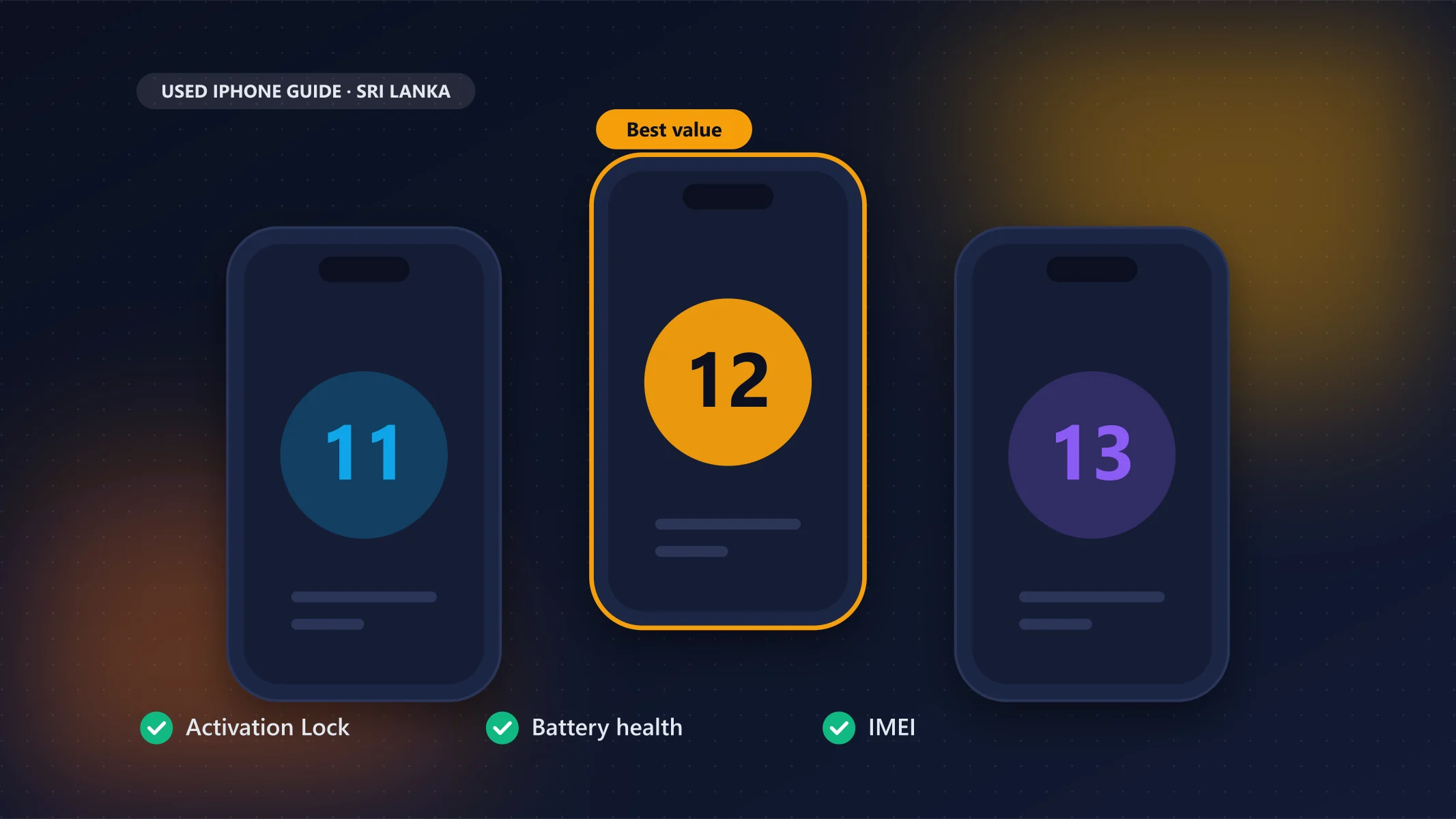
Best Second-Hand iPhones in Sri Lanka (2026 Buying Guide)
For most buyers in Sri Lanka the iPhone 12 (128GB, about Rs 78,000 asking) is the best-value used iPhone; the iPhone 11 is the cheapest model Apple still lists for iOS 27.
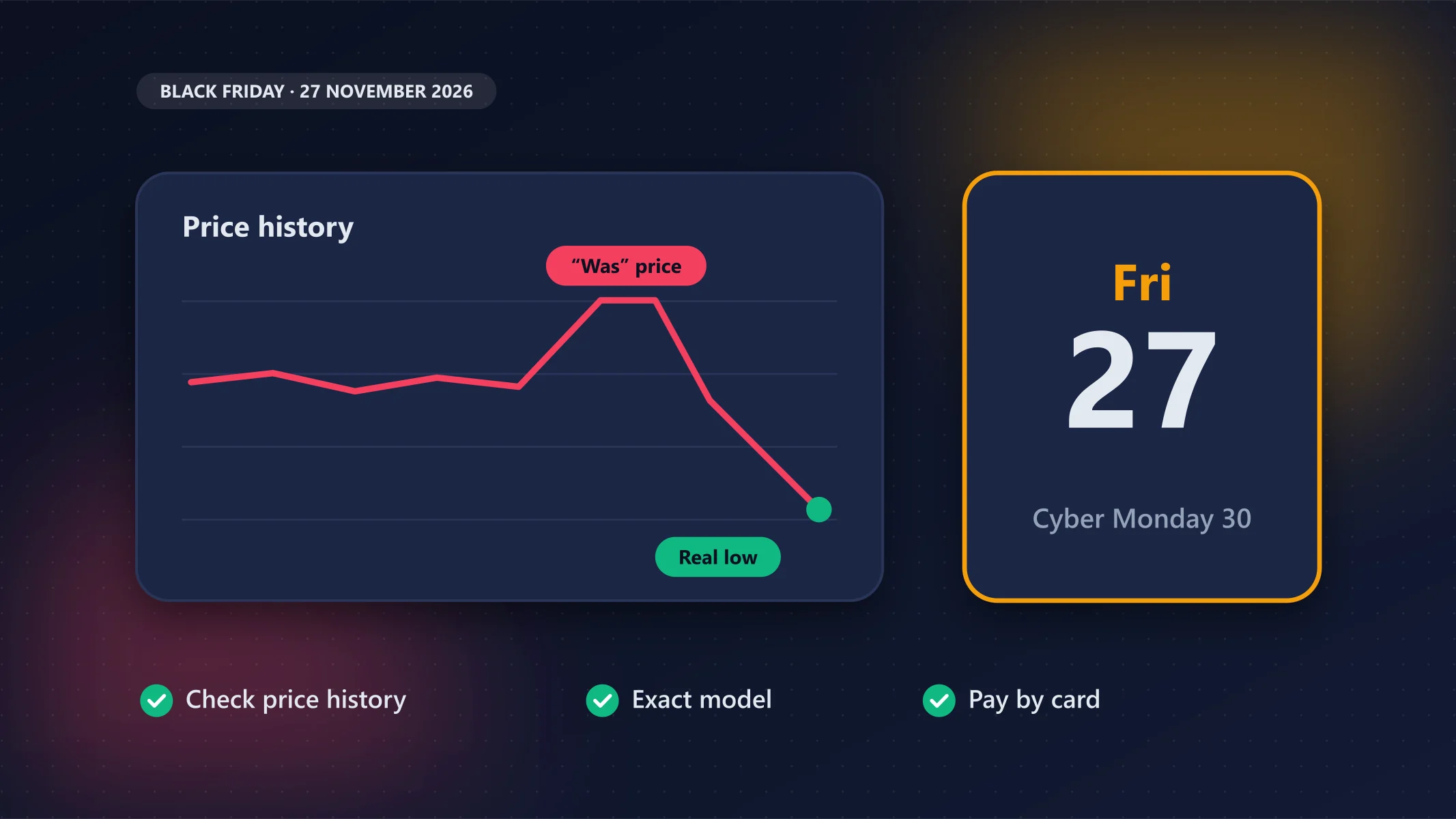
Black Friday 2026: Dates and How to Tell a Real Tech Deal From a Fake One
A Black Friday price is only a deal if the price history says so: check it with Google Shopping, CamelCamelCamel or Keepa before you buy, and pay by credit card.
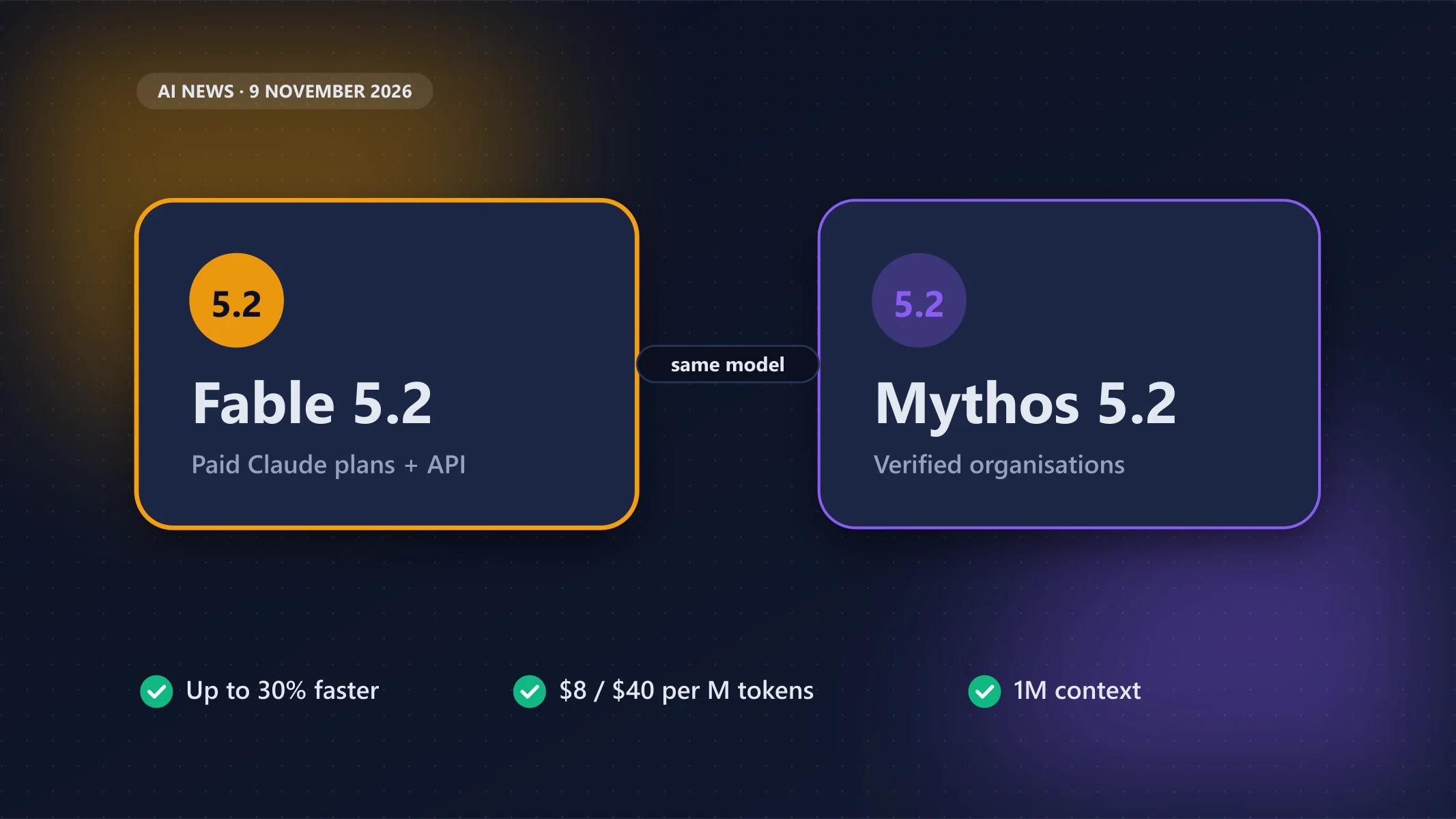
Claude Fable 5.2 and Mythos 5.2: What’s New, Price and Who Gets It
Fable 5.2 is Anthropic’s most capable model for hard technical work and is cheaper than Fable 5.1; for everyday chat and coding, Anthropic itself still points people to Claude Opus 5.5.